
AI for Medical Documentation in DME: How It Works and Where It Helps
July 25, 2026
CO-4 Denial Code: Procedure and Modifier Mismatches in DME
August 4, 2026
A medical claims audit is a review verifying that a submitted claim is accurate and supported by proper documentation.
For heavily monitored DME providers, this guide explains audit types, what reviewers check, why you get flagged, and how to prepare. Ultimately, an audit is about what you can prove, not what you did wrong.
What Is a Medical Claims Audit?
A medical claims audit occurs when a health payer or contractor reviews a claim to confirm it is accurate and backed by proper clinical documentation. If the reviewer finds discrepancies or missing information, the payer recoups the overpaid funds. These reviews generally fall into two distinct timing categories.

Prepayment audits evaluate claims before the payer disburses any money to prevent wrongful payouts. Post-payment audits examine claims after the money has already reached your bank account to recover erroneous disbursements. In both scenarios, an audit is about what you can prove through paperwork, not necessarily what you did wrong during patient care.
The Main Types of DME Claims Audits
Durable Medical Equipment claims face strict regulatory monitoring through a tiered contractor framework designed to verify billing compliance and prevent financial loss.
| Contractor Type | Administrator | Timing | Primary Trigger |
| CERT | Empirical QA / The Lewin Group | Post-payment | Random sampling to measure the national improper payment rate |
| TPE | Regional DME MACs | Prepayment or Post-payment | High denial rates or extreme billing outliers compared to peers |
| RAC | Cotiviti, LLC | Post-payment | Data mining algorithms flagging coding anomalies or duplicate payments |
| UPIC | Regional integrity contractors | Prepayment and Post-payment | Suspected fraud, OIG alerts, or whistleblower reports |
| SMRC | Noridian Healthcare Solutions | Prepayment and Post-payment | CMS-directed projects focusing on specific national vulnerabilities |
What Auditors Actually Check
During a medical claims audit, documentation is the entire game because auditors do not look at the patient. They only look at the paperwork to determine if a service happened and if it was legally justified.
Every denial is ultimately a documentation failure, making the following structural elements the primary targets of any review:
- Valid Standard Written Order (SWO): Verifying the order contains all federally mandated elements, including the patient name, detailed equipment description, clinician signature, and NPI.
- Face-to-Face Encounter and WOPD: Confirming a physician documented an in-person or telehealth visit within required timeframes, and that a Written Order Prior to Delivery was fully executed before the equipment crossed the threshold.
- Compliant Proof of Delivery (POD): Auditing logs to ensure they feature a valid, legible patient signature alongside the exact calendar date of receipt.
- Underlying Clinical Necessity: Scrutinizing independent chart notes to confirm they objectively prove the item is medically required.
- HCPCS and Modifier Precision: Cross-referencing the billed code against the equipment description while ensuring mandatory modifiers are accurately appended.
- LCD Utilization and Frequency Alignment: Checking that the quantity of supplies aligns exactly with Local Coverage Determinations, flagging overages lacking documented justification.
Why DME Suppliers Get Audited More
Durable Medical Equipment suppliers face disproportionately higher audit frequencies due to systemic vulnerabilities in billing metrics and an inherent structural reliance on external data.
According to the Centers for Medicare and Medicaid Services Comprehensive Error Rate Testing report, the improper payment rate for DME suppliers reached 24.12%, totaling over $2.27 billion in erroneous outlays. This error rate is nearly four times higher than the overall Medicare fee-for-service improper payment rate of 6.55%. This statistical disparity automatically flags the entire sector as a primary target for federal oversight and fiscal recovery.

Unlike standard healthcare providers who document the care they personally deliver, DME suppliers do not generate the primary medical records used to justify their claims. You depend completely on independent physicians to provide the detailed chart notes and signed orders required for compliance.
When an agency reviews a claim, any missing details or vague phrasing within a physician record results in a swift administrative denial for your business, even if the equipment was correctly delivered.
Furthermore, federal regulatory changes have significantly amplified administrative scrutiny. Expanded authorities allow auditing entities to execute widespread retroactive post-payment sampling, pulling historical records years after a claim was processed to capture technical or administrative errors.
How to Stay Audit-Ready (Catch Gaps at Intake)
True audit-readiness for a medical claims audit is not a panicked scramble that begins when an audit letter arrives. It is a continuous defensive strategy built directly into the front-end intake process when a patient record is first assembled.

Capturing and correcting documentation vulnerabilities at the point of ingestion helps prevent technical denials and prolonged post-payment disputes.
- Stop treating intake as basic data entry. Shift your operational mindset so intake staff function as primary compliance gatekeepers verifying clinical parameters.
- Implement immediate rule validation. Cross-reference incoming physician documentation against product coverage requirements and strict Local Coverage Determinations before scheduling delivery.
- Proactively identify omission trends. Track common missing chart elements to flag problematic ordering clinics early.
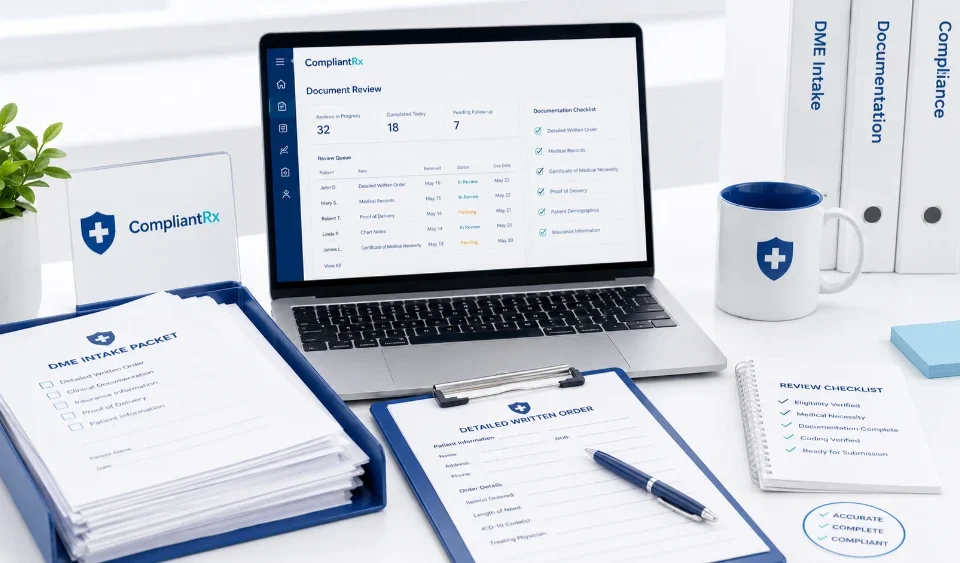
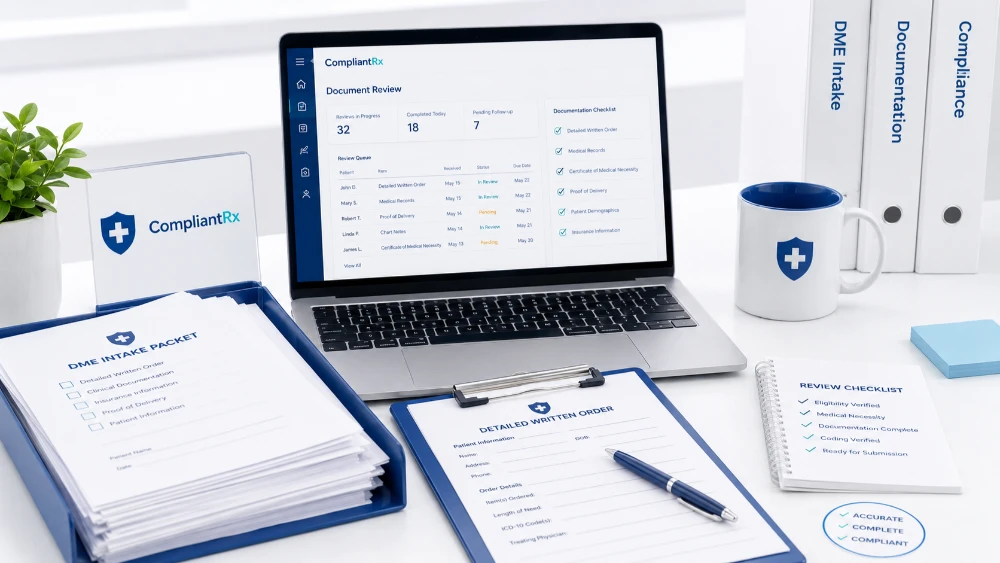
At CompliantRx, we standardize this workflow using software engineered directly by experienced DME operators to replace manual reviews with structured protection.
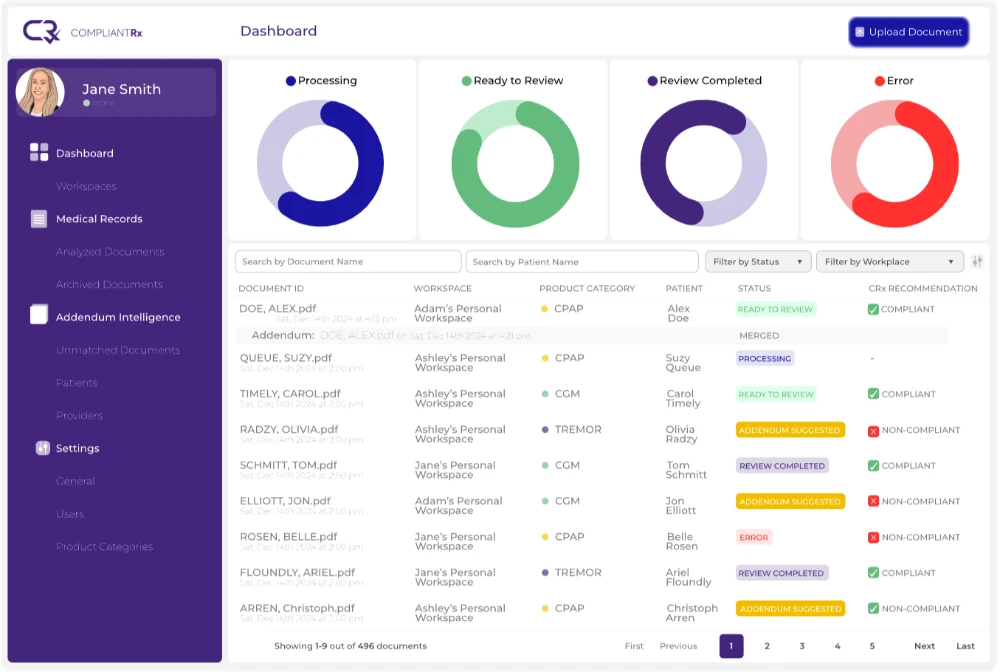
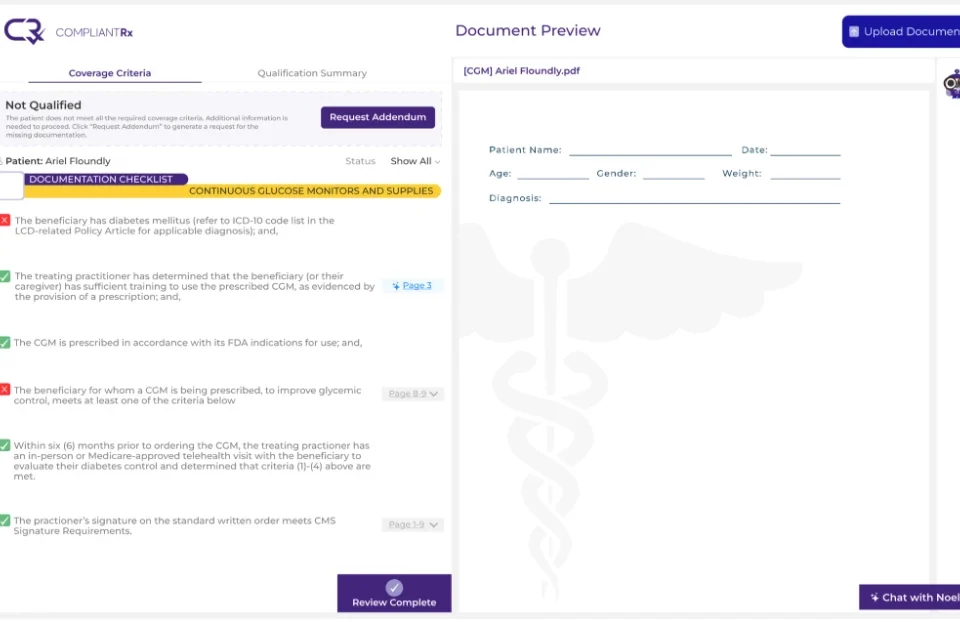
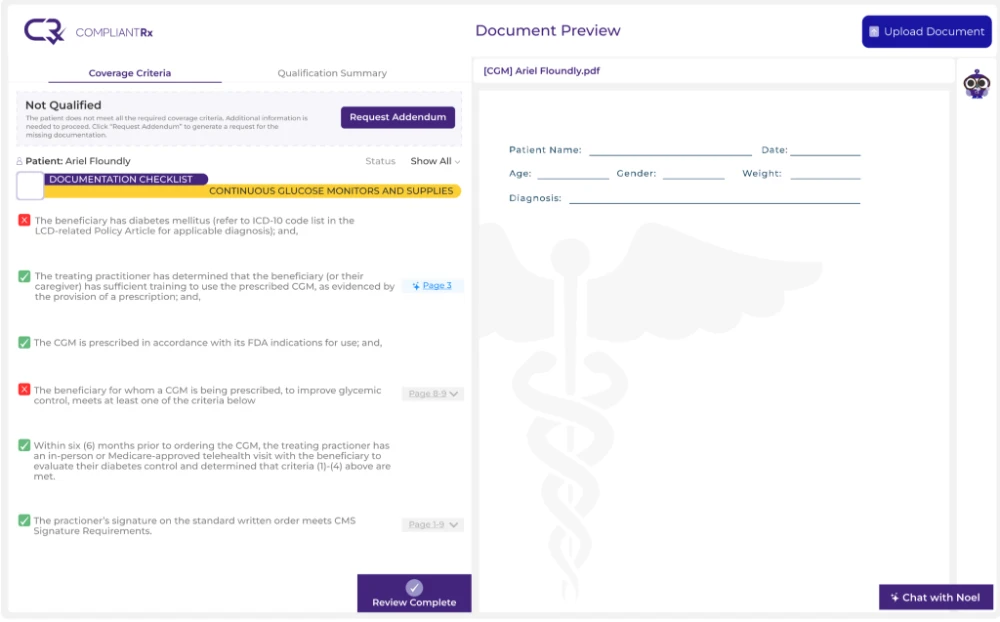
Our AI Medical Record Review engine analyzes incoming doctor notes and orders against intricate payer-specific criteria, highlighting deficiencies that would trigger a contractor denial. When clinical gaps arise, our Addendum Intelligence™ feature streamlines the correction process by generating precise documentation requests to close those physician gaps before the claim leaves your facility.
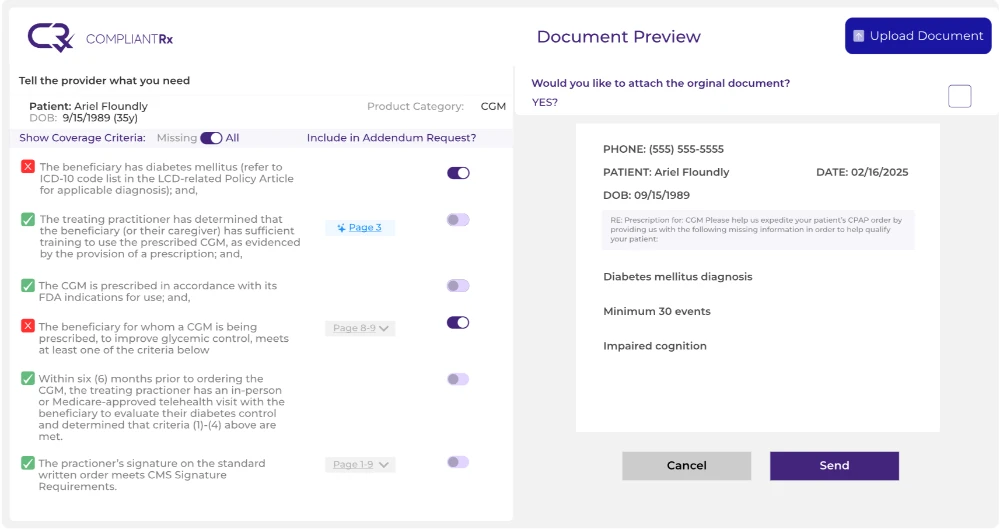
Every automated check and rule evaluation is logged dynamically, providing an accessible defensive history that validates billing compliance.
Schedule a demo to see how CompliantRx keeps your documentation audit-ready from intake.
FAQs
Navigating a medical claims audit requires a clear understanding of the processes and timelines involved.
Q: What is the difference between a prepayment and post-payment audit?
A: The main difference is the timing of the review. A prepayment audit checks claims before the insurance company pays them, while a post-payment audit reviews claims after the money has already been sent. Both look closely at medical records and coding accuracy.
Q: What triggers a DME audit?
A: An audit is typically triggered by billing anomalies, high claim volumes, and documentation errors. Common red flags include upcoding or unbundling items, recurring rental spikes, and statistical billing outliers compared to peer providers.
Q: How far back can a DME audit go?
A: A standard Medicare audit generally goes back three years from the date the claim was paid. This can extend to six years under the 60-day overpayment rule, or up to ten years under the federal False Claims Act if fraud is suspected.
Q: What happens if you fail a DME claims audit?
A: Failing an audit results in an official overpayment demand letter, financial recoupment, and potential escalation to debt collection. You have a strict five-level administrative appeal process to challenge the findings, starting with a redetermination through your MAC, moving to reconsideration by a Qualified Independent Contractor, and potentially escalating to an Administrative Law Judge, the Medicare Appeals Council, and federal court.
Q: How do I prepare for a DME audit?
A: To prepare for a DME audit, gather core documentation including standard written orders, medical necessity clinical notes, and proof of delivery. For a comprehensive preparation guide, visit our Prepare for a DME Audit page.