
HME vs DME: What’s the Difference?
July 20, 2026
Medical Claims Audit for DME: What to Expect and How to Prepare
August 1, 2026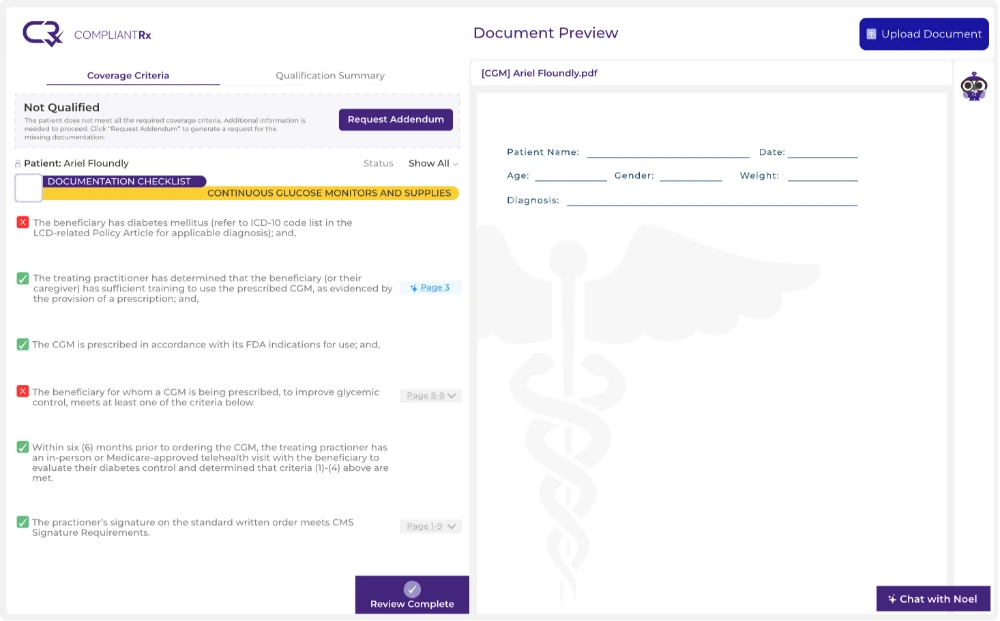
AI for Medical Documentation in DME: How It Works and Where It Helps
AI for medical documentation in DME is software that reads incoming referrals and orders, extracts key details, and checks them against payer rules before a claim is built.
In practice, that means intake teams can stop spending twenty to thirty minutes per order by hand. Here is how the process works, where it helps most, and what it cannot do.
What Is AI for Medical Documentation in DME?
This type of AI processes inbound clinical documents, such as faxes, physician orders, Letters of Medical Necessity (LMNs), and clinical notes. It extracts unstructured data into structured fields and cross-references that information against insurance payer and product rules to identify compliance gaps before a billing claim is generated.
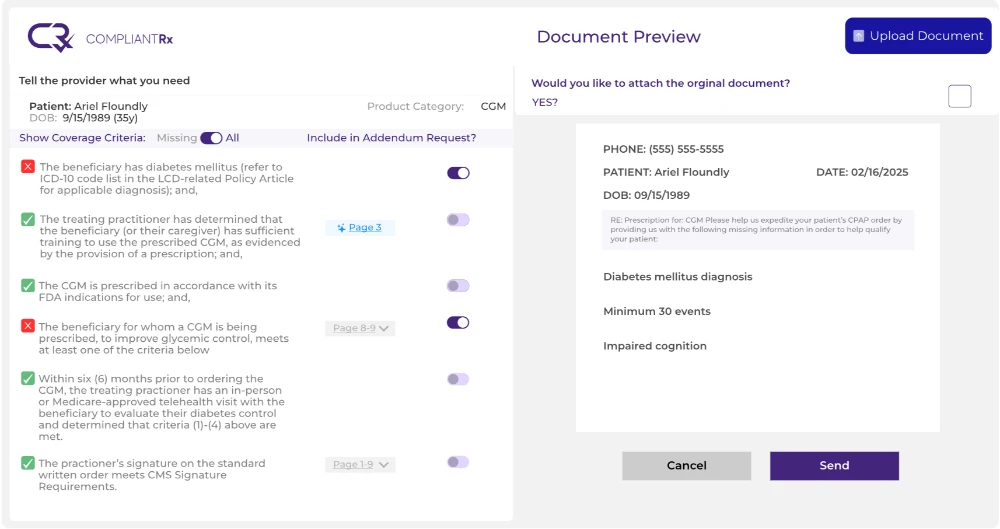
Unlike ambient clinical-scribe AI, which listens to live doctor-patient conversations to generate notes for clinicians, DME documentation AI processes existing text documents to audit billing compliance for administrative and intake staff.
How It Works: The Intake-to-Compliant-Record Flow
AI for medical documentation follows a repeatable sequence from the moment a document arrives to the point where a compliant record is ready for billing. Here is how the flow typically runs:
- Document ingestion and OCR: The system receives inbound faxes or uploads and applies Optical Character Recognition (OCR) to convert static image files into searchable, machine-readable text.
- NLP extraction: Natural Language Processing (NLP) parses the unstructured text to identify and extract key clinical data points, including diagnoses (ICD-10 codes), equipment types, HCPCS codes, and specific clinical criteria.
- Rule checking: The software automatically cross-references the extracted data against relevant Local Coverage Determinations (LCDs), National Coverage Determinations (NCDs), and specific payer checklists.
- Gap flagging: The AI evaluates the clinical data for completeness, instantly flagging missing required elements, contradictions, or unfulfilled insurance criteria.
- Addendum generation: If documentation gaps are found, the system auto-generates a targeted clinical addendum or clarification request for the ordering provider to sign.
- System write-back: Once the record is audited and complete, the finalized, structured data and compliant documents are written directly back to the DME provider’s primary system of record.
Where AI Helps Most in DME Documentation
AI for medical documentation delivers the most value when it is applied to high-frequency compliance checks that currently consume large blocks of staff time. These are the use cases where DME teams often see the clearest impact:
- Medical necessity validation at intake: The tool audits inbound physician notes to ensure the clinical text explicitly justifies the requested equipment.
- Prior-authorization document assembly: It automatically packages required charts, lab results, and testing data into formatted submission packets for faster payer approval.
- LMN and SWO completeness checks: The system verifies that Letters of Medical Necessity and Standard Written Orders contain all mandatory provider signatures, dates, and NPI numbers.
- Same-or-similar and LCD utilization flags: It screens patient history against Local Coverage Determinations to catch duplicate equipment line items or premature replacement requests.
- Audit-trail generation: It creates an automated, time-stamped log of all clinical data extractions and compliance checks to support defense during future RAC or CERT audits.
What AI Can’t (and Shouldn’t) Do
Using AI for medical documentation does not mean handing over clinical or compliance decisions to the software. Understanding what the technology is not designed to do helps set realistic expectations and keeps workflows safe.
- Cannot replace clinical judgment: AI lacks the nuanced understanding required to evaluate complex, edge-case patient conditions or subjective provider intent.
- Should not autonomously deny care: System flags serve strictly as administrative warnings, never as automated decisions to reject a patient’s order.
- Requires human-in-the-loop sign-off: A trained intake specialist or clinician must review and validate all AI-extracted data before finalizing a claim.
- Cannot legally sign orders: The software can draft documentation addendums, but only the licensed ordering physician can legally authorize or amend a prescription.
- Does not eliminate liability: Ultimate compliance accountability remains with the DME provider, so AI-generated outputs must be consistently audited for accuracy.
What to Look for in an AI Documentation Tool for DME
Choosing the right AI for medical documentation comes down to fit, accuracy, and control. The following criteria can help you evaluate whether a tool will work in a real DME operation without disrupting existing workflows.
- DME-specific rule engines: Avoid generic medical checklists. The tool must understand the hyper-specific, nuanced documentation criteria unique to complex rehab, mobility, and respiratory equipment.
- Dynamic payer and LCD coverage: Look for systems that automatically update their rule sets continuously as local MACs alter Local Coverage Determinations (LCDs) and National Coverage Determinations (NCDs).
- Native system-of-record integration: The software should plug directly into your existing DME billing and intake platforms via APIs or secure bots, preventing a costly operational overhaul.
- Immutably documented audit trails: Every automated extraction, verification check, and human modification must be logged with a timestamp to provide a defensible record during payer audits.
- Human-in-the-loop architecture: The interface must cleanly present AI findings side-by-side with original source documents, making it straightforward for intake staff to verify, edit, and sign off on data.
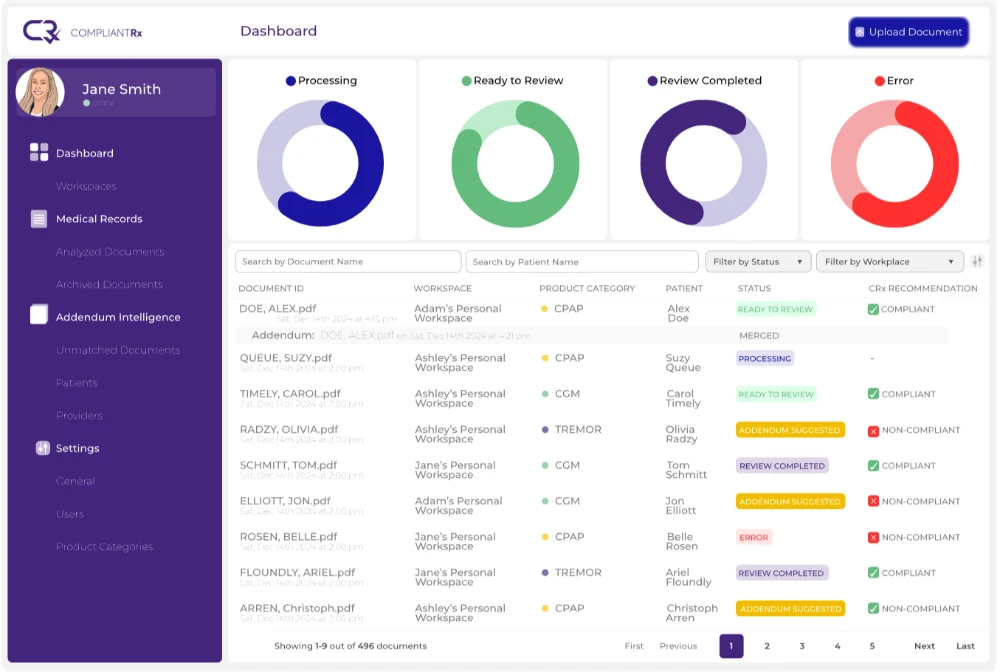
CompliantRx reflects these operational needs through tailored feature suites built specifically for DME:
- AI Medical Record Review cross-references unstructured physician notes against strict coverage criteria to confirm medical necessity before submission.
- Intelligent Data Extraction pulls messy, unstructured data from incoming faxes and maps it directly to your system-of-record fields, reducing repetitive entry.
- Addendum Intelligence™ auto-generates precisely worded, compliant documentation clarifications for the ordering physician when gaps are detected, accelerating the signature loop.
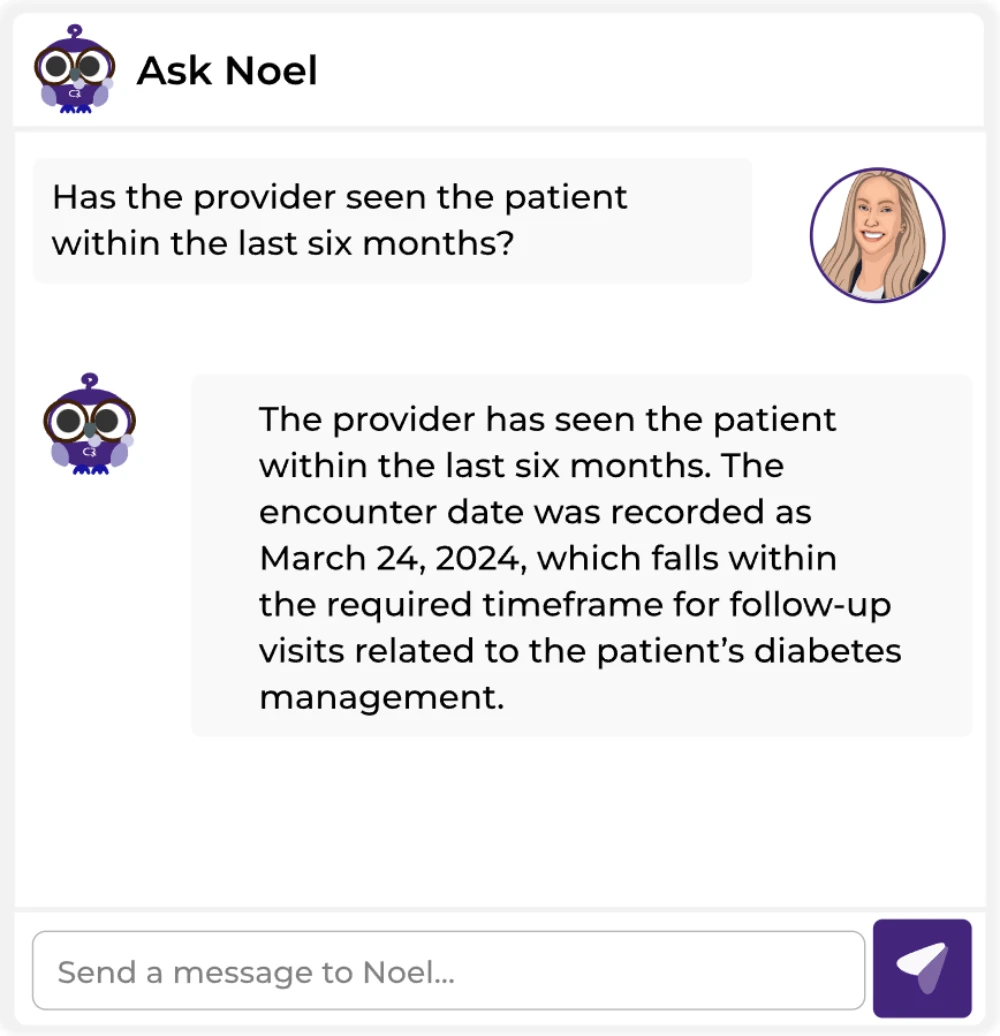
- Ask Noel® is an on-demand clinical documentation assistant that lets intake teams query specific patient files or payer rules using natural language to resolve complex billing questions quickly.
Schedule a demo to see how CompliantRx applies AI to your DME documentation at intake.
FAQs
These questions cover common points about AI for medical documentation and how CompliantRx approaches each one.
Q: Is AI for medical documentation the same as an AI medical scribe?
A: No. A medical scribe generates clinical notes from live conversations. AI for DME documentation reads existing orders and checks them against payer rules.
Q: Does AI replace the intake team?
A: No. It augments the team. A person reviews and signs off before any claim is finalized.
Q: Can AI check documentation against Medicare LCDs?
A: Yes. Matching documentation to LCD and NCD criteria is a core use case of this technology.
Q: Is AI documentation review HIPAA-compliant?
A: Yes. CompliantRx states its platform is HIPAA compliant by design, with end-to-end encryption and role-based access controls to protect protected health information.
Q: How much time does AI save on DME intake?
A: Many DME providers report reducing per-order review from twenty to thirty minutes down to two to four minutes when the AI handles initial extraction and rule checks. For more on how this works in practice, visit our AI Medical Record Review page.
Learn more about AI Medical Record Review: https://www.compliantrx.ai/compliantrx-solutions/ai-medical-record-review/