

The 8 Most Common DME Claim Denials (and How to Prevent Each One)
July 10, 2026
PR-204 Denial Code Description: What It Means for DME Suppliers
July 13, 2026
Denial Management in Medical Billing: A DME Supplier’s Guide
Denial management in medical billing is the systematic process of identifying, analyzing, appealing, and preventing insurance claim rejections.
For DME suppliers, mastering this lifecycle is critical to recovering revenue and maintaining cash flow. However, most post-denial rework is wasted motion because the rejection was preventable at intake.
What is Denial Management?
Effective denial management in medical billing requires a structured approach to handling rejected claims. Suppliers must follow a four-stage lifecycle to identify issues, analyze root causes, appeal decisions, and prevent future errors.
1. Identify
The first step involves capturing and recognizing denied claims immediately after receiving them.
Billing teams review the Explanation of Benefits (EOB) or Electronic Remittance Advice (ERA) from the payer to identify the specific Claim Adjustment Reason Codes (CARC) that triggered the denial.
Common DME examples include:
- Codes indicating missing modifiers, such as RT or LT
- Denials for unlisted or invalid HCPCS codes

2. Analyze
During the Analyze phase, teams categorize and investigate the root cause of the rejections.
Instead of treating denials on a claim-by-claim basis, the billing team groups them to uncover broader operational issues. Identifying patterns where claims are consistently denied due to a missing Standard Written Order (SWO) or inadequate physician documentation helps suppliers address front-end versus back-end errors.
3. Appeal
The appeal stage focuses on correcting errors, resubmitting claims, or formally disputing the refusal to pay.
The team must execute specific actions to overturn the decision:
- Gathering the required supporting documentation, such as clinical notes or prior authorization proof
- Writing a formal appeal letter that addresses the specific denial reason
- Submitting the dispute within the payer’s strict timely filing and appeal windows
4. Prevent
The final stage involves implementing systemic changes to stop the same denials from occurring on future claims.

The insights gained during the Analyze phase are used to train staff, update billing software, and adjust pre-submission workflows. Instituting hard stops in the DME intake process ensures insurance eligibility is verified, prior authorizations are confirmed, and all necessary physician documents are signed before delivering any equipment. This elevates standard denial management practices into a proactive strategy.
Why It’s Harder for DME
Denial management in healthcare presents unique challenges for DME suppliers due to stringent medical necessity proofs and strict modifier usage. The physical proof of delivery requirement and coordination with referring physicians make reworking a denied claim slower and more costly.

The unique complexities of DME billing that make denials particularly difficult include:
- Stringent Documentation Standards: Payers require extensive documentation, such as a Standard Written Order (SWO) and supporting clinical records, proving the equipment is medically necessary. A physician signature error or missing functional assessment can result in denial, stalling the revenue cycle.
- Proof of Delivery: For physical goods, suppliers must have a signed and dated delivery receipt or a traceable courier tracking number. Missing this specific paperwork is a major reason for claim rejections.
- Complex HCPCS and Modifiers: DME billing relies heavily on HCPCS Level II codes paired with specific modifiers, such as NU for new or RR for rental. Using the wrong modifier or missing a code laterality can trigger a denial.
- Same or Similar Equipment Rules: Payers, especially Medicare, deny claims if the patient has received the same or similar equipment (usually within a five-year timeframe). Checking this history beforehand requires manual vetting or specialized portal checks.
- Prior Authorization Hurdles: Payers often require pre-approval before an item is shipped to the patient. If the authorization is missing, expired, or does not match the billed code, the claim is typically denied, costing your team valuable rework time.
Shifting to Prevention
Traditionally, revenue cycle teams waste valuable minutes per claim manually chasing missing signatures, invalid modifiers, or out-of-date physician notes after a denial occurs. The proactive turn requires shifting this compliance check to the intake phase. By validating every required clinical element before a claim is billed, suppliers prevent revenue leakage and reduce administrative waste.
The Practical Workflow and The AI Mechanism
Modern intake tools unify data entry and medical record review through AI to catch errors before they reach the payer.
AI engines using machine learning and natural language processing scan patient documents, such as physician notes, lab results, and face-to-face encounters, and align that clinical data against payer-specific requirements.
Real-Time Alerts: If a required element is missing, such as sleep-study results for a PAP order or a face-to-face encounter date for a CGM, the system triggers a real-time compliance alert. The intake team is notified instantly and can request addendums while the patient chart is still active.
CompliantRx Solution
To prevent these denials at the source, suppliers can add CompliantRx to their existing intake workflow.
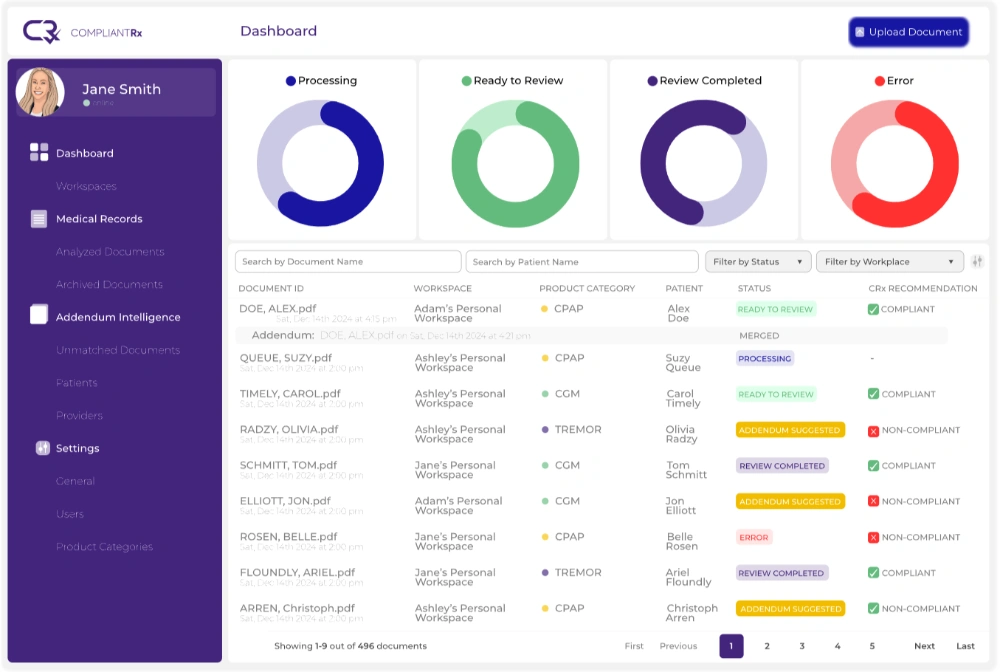
CompliantRx is an AI-powered intake and compliance platform built by a DME operator, for the DME space. It works at the front of the workflow, reviewing incoming documentation before a claim is ever built, so the gaps that cause denials get caught while the order is still in intake.
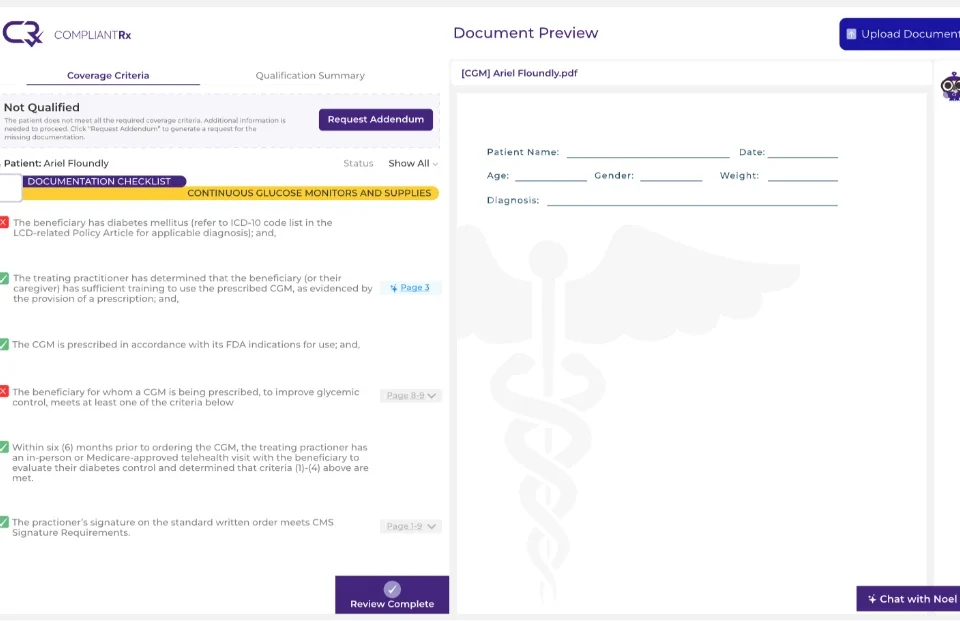
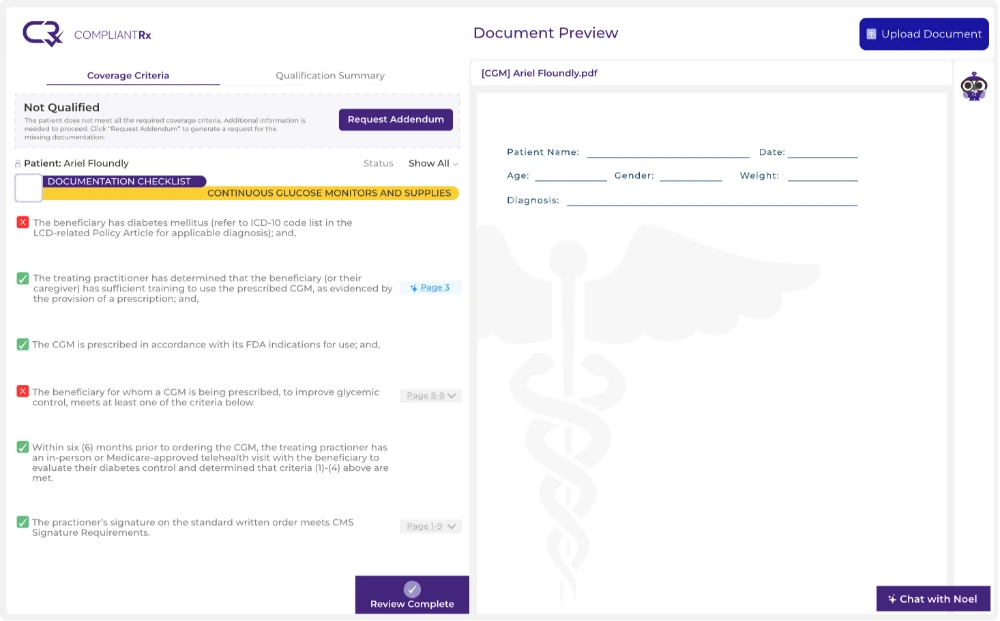
- AI Medical Record Review: Scans incoming documentation against payer- and product-specific criteria, reducing a manual review that typically takes 20–30 minutes to just a few.
- Intelligent Data Extraction: Pulls critical data fields from faxes and referrals and flags missing documentation before a claim is generated.
- Addendum Intelligence: Auto-generates the corrective addendum to send back to the provider for anything that’s missing.
- Ask Noel®: Gives your team precise, product-specific answers to complex compliance questions, with an audit-ready, traceable documentation history.
- Bi-directional integration: Connects with systems of record like Brightree and NikoHealth without an IT overhaul.
Key Takeaways: Prevent Denials Before They Happen
Denial management in medical billing often wastes resources on reworking claims that should have been prevented at intake. By shifting from downstream recovery to upstream documentation integrity, DME suppliers can protect cash flow and reduce administrative burden.
CompliantRx validates records at intake and helps prevent denials before a claim is ever submitted. Schedule a demo to see how it fits your workflow.
FAQs
Understanding denial management in medical billing is critical for DME suppliers looking to protect their revenue.
1. What is the most common cause of DME claim denials?
Missing or incomplete documentation, such as lacking a physician signature, is the most frequent cause of DME claim denials. Payers require strict proof of medical necessity before they will approve equipment for in-home use.
2. What is a Claim Adjustment Reason Code?
A CARC is a standard code used by payers to explain why a claim was denied or adjusted. Reviewing these codes helps billing teams categorize issues and identify systemic problems in their intake workflow.
3. What happens if a claim is denied for missing proof of delivery?
The supplier must provide a signed delivery receipt or traceable courier tracking number to overturn the denial. Without this physical proof, the payer will recoup the payment or refuse to pay the initial claim.
4. Why are modifiers so important in DME billing?
Modifiers provide specific details about the equipment, such as whether it is a rental or a new purchase. Submitting a claim with the wrong modifier can trigger a rejection from the payer system.