
What DME Suppliers Should Know About AI in Billing and Coding
September 14, 2026
If a CO-29 denial code just landed on your remittance, it means the payer is saying your claim arrived after the filing deadline. The claim becomes a write-off unless you can prove otherwise. This guide explains what CO-29 means, how to check if it is actually valid, and how DME suppliers can stop it from happening again.
What triggers a CO-29 denial code on a DME claim
CO-29 shows up when a claim reaches the payer after their timely filing deadline has passed. Medicare gives suppliers 12 months from the date of service. Medicaid and commercial payers often set shorter windows, sometimes as little as 90 days.
In DME billing, the clock usually runs out for reasons that start upstream, not at the billing desk. Common causes include:
- Waiting on missing signatures or documentation from the referring provider
- Resubmitting a claim after an addendum request, which eats into the original window
- Delays moving data between intake and the billing system
How the CO group code changes who absorbs the cost
CO stands for Contractual Obligation. It means the write-off is the supplier’s responsibility under the payer contract. A CO denial cannot be billed to the patient, even for the coinsurance portion.
Checking whether your CO-29 denial code is actually valid
Not every CO-29 is accurate. Payers sometimes flag a claim as late when it was actually submitted on time but never fully processed on their end. Before accepting the write-off, it is worth confirming the details.
Confirm the payer’s specific filing deadline
Every payer sets its own timely filing window, and it is calculated from the date of service, not the date the claim was prepared. Check the payer’s published deadline against your actual date of service before assuming the denial is correct.
Gather proof of timely submission
If the claim was sent within the window, you need evidence to prove it. Useful records include:
- Electronic Data Interchange (EDI) acceptance reports
- Clearinghouse submission logs
- Timestamped records from your system of record
Steps to appeal a CO-29 denial code claim
If you have proof the claim was filed on time, you can move to an appeal. What that appeal looks like depends heavily on the payer.
Build a complete appeal packet
A strong appeal packet includes your proof of timely filing, a copy of the original claim, and a short written explanation of the discrepancy. Keep the group code as submitted. Never alter it during an appeal.
The Medicare difference
Commercial payers generally allow you to appeal a CO-29 through their standard redetermination process, as long as you have proof of timely filing.
Medicare works differently. A CO-29 denial from Medicare is not appealable through standard redetermination. Instead, suppliers must file a claim reopening under CMS Pub. 100-04, Chapter 34, Section 70.7, and only one of a small set of CMS-recognized exceptions will qualify. Knowing this distinction before you file can save weeks of back and forth with the wrong process.
Preventing CO-29 denials in your DME intake workflow
Fixing CO-29 denials after they happen is slower and less reliable than preventing them. Most of the real leverage sits at intake, before a claim is ever billed.

Flag orders before the filing window closes
Track how long each order has been sitting since the date of service, not just since it reached billing. Orders approaching the deadline should be flagged automatically so they do not slip through.
Missing documentation is one of the most common reasons an order sits too long before it is ready to bill. Confirming the documentation Medicare actually requires at intake, rather than after a denial, keeps orders moving toward submission instead of toward the deadline.
Track every claim to acceptance, not just submission
A claim can be sent on time and still trigger a CO-29 if it is rejected at the clearinghouse and never reaches the payer. Submitted is not the same as accepted.
Tracking claims through to acceptance closes this gap. A clean, fast intake process means claims go out earlier, leaving room to catch and fix a clearinghouse rejection before the filing window closes. For a broader look at where DME claims tend to break down, see the most common denial reasons in DME billing.
How CompliantRx helps DME suppliers catch issues before claims go out
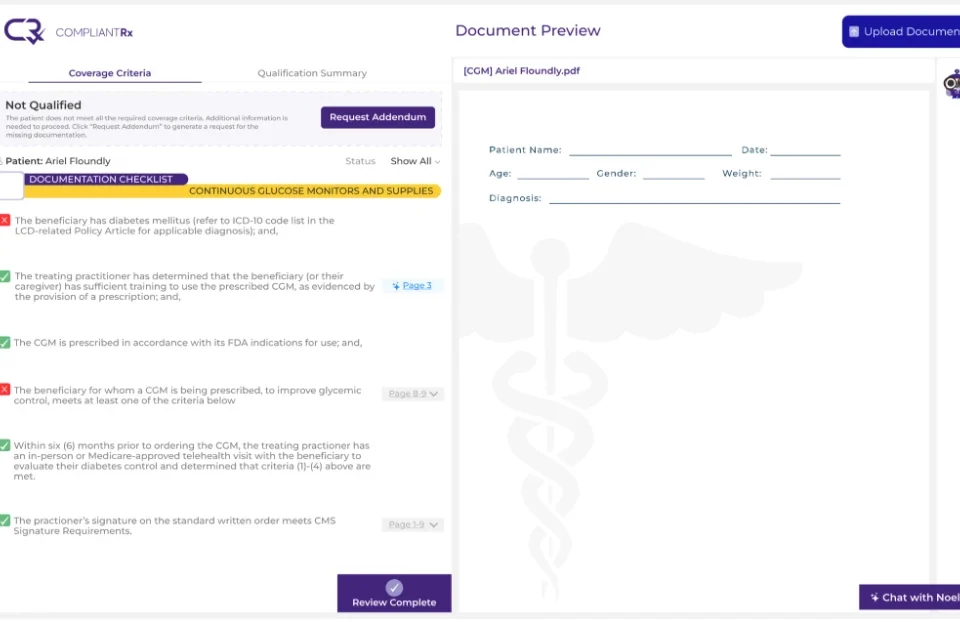
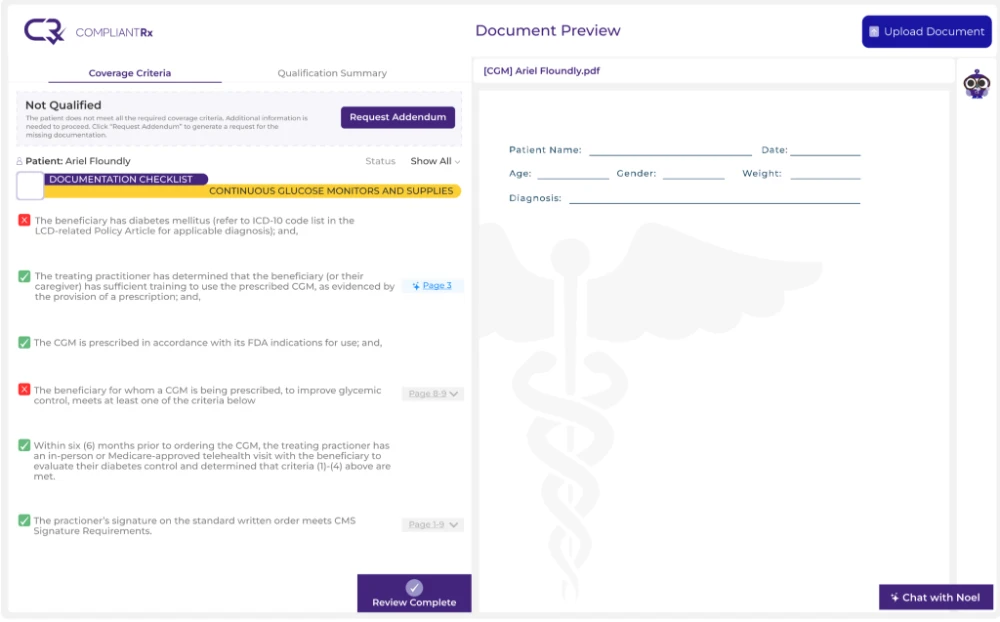
CompliantRx works at intake, not at billing. Instead of a compliant record taking 20 to 30 minutes to assemble by hand, CompliantRx gets it done in about 2 to 4 minutes. That extra time gives claims more room to go out early, with margin against the filing clock, instead of getting stuck behind documentation delays.
Want to see how it fits your intake workflow? Schedule a demo with CompliantRx to walk through it.
FAQs
1. Does CO-29 apply to Medicaid DME claims?
Yes. Medicaid programs set their own timely filing limits, which are often shorter than Medicare’s 12 month window, so the same CO-29 logic applies.
2. What’s the difference between CO-29 and PR 27?
CO-29 means the claim was filed late, and the supplier absorbs it as a write-off. PR-27 is a different issue, where the patient’s coverage had already terminated when the service was provided, so responsibility may fall to the patient. The two aren’t interchangeable.
3. Can a CO-29 denial ever be billed to the patient?
No. The CO group code means the adjustment is the supplier’s responsibility under the payer contract, not the patient’s.
4. Is CO-29 appealable for Medicare claims?
Not through standard redetermination. Medicare requires a claim reopening under CMS Pub. 100-04, Section 70.7, and only specific exceptions qualify.