Prior Authorization Automation: What Works, What Doesn’t, and What It Saves
September 27, 2026
Prior Authorization Software: The Criterion That Actually Matters for DME
October 5, 2026
AI prior authorization is the use of artificial intelligence to help prepare, check, and support prior authorization requests, from reading the chart to filling out the form.
Many people picture AI as simply autofilling the request form, and it does that. The more valuable work happens around the form, where AI can read the chart, pull the clinical evidence a payer requires, check it against that payer’s criteria, and draft the language to fix whatever is missing.
This article explains what AI can do at each step and why closing a gap matters more than only flagging it.
What AI prior authorization actually does (beyond the form)
AI prior authorization usually covers four jobs:
- Requirement detection: spotting when a prior authorization is needed based on the product code and payer
- Clinical evidence extraction: reading unstructured notes to pull out the diagnosis, prior therapy, and lab values
- Validation: checking that evidence against payer specific medical necessity criteria
- Form population: filling out and submitting the request
Form filling and submission are real parts of the process, and they save time. They are only the visible tip, though, because the first three jobs decide whether the request contains what the payer needs to see.
Reading a chart is also harder than it sounds, since clinical details are often buried in free text notes and scanned faxes. AI tools that combine text recognition with language models can pull those details out faster than a manual hunt through the chart.
Flagging a gap vs. closing it
Many tools stop once they find a problem, while others go one step further and fix it. The table below shows the difference.
| Flagging a gap | Closing a gap |
| Detects that a prior authorization is required | Drafts a corrective addendum for the missing item |
| Extracts clinical evidence from the chart | Produces payer ready language the provider can review and sign |
| Validates evidence against payer criteria | Gets the missing documentation back from the provider |
| Identifies what is missing | Reassembles the complete record once the fix arrives |
A flag still leaves a person to work out what to ask for, write the request, and chase the provider. Closing the gap removes that extra work, which is where much of the time per order goes.
For that reason, the ability to close a gap, not just flag it, is the difference worth looking for when comparing tools. See how Addendum Intelligence™ turns a flagged gap into corrective language.
The line AI shouldn’t cross: recommend, don’t decide
Provider side AI should assemble and strengthen a request, but it should not make the clinical approval decision. That decision belongs to the payer, and the judgment behind the request belongs to the treating practitioner and your team.
The concern is real on the payer side. An AMA survey found that 61% of physicians are concerned that health plans’ use of AI is increasing prior authorization denials.
Good AI keeps a person in the loop for judgment calls and high risk cases. Warning signs that a tool goes too far include:
- It claims to approve or deny requests on its own
- It makes clinical decisions without a person reviewing them
- It cannot show how it reached a result

How CompliantRx closes the gap
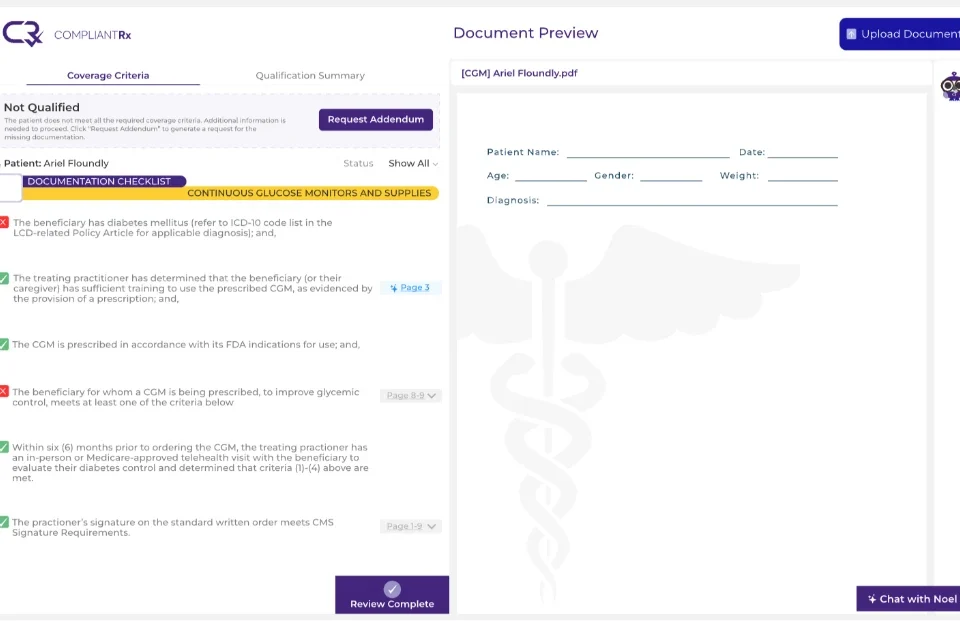
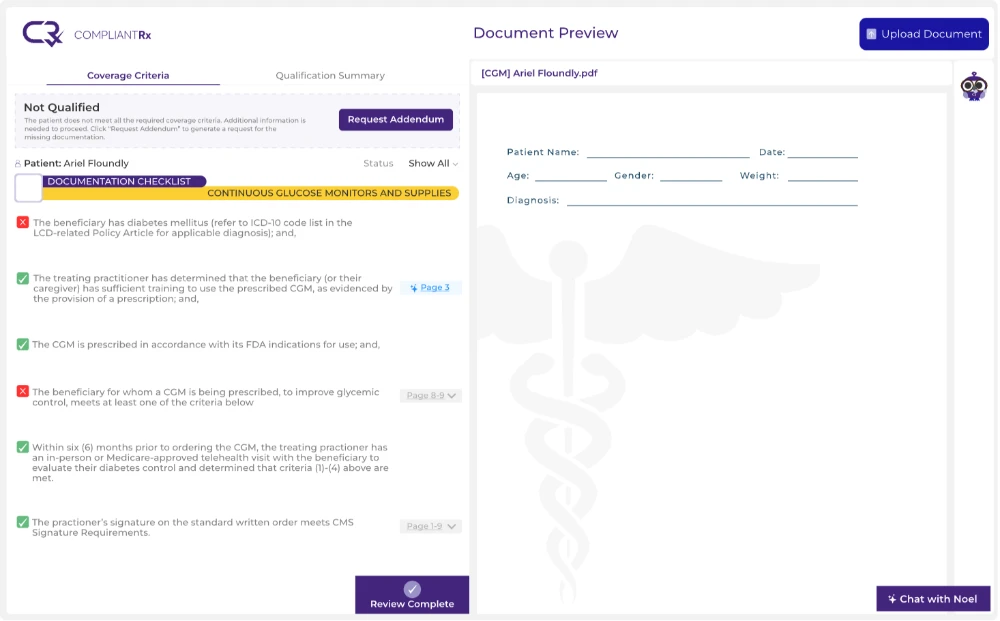
CompliantRx works at intake, before a prior authorization request goes out. It extracts clinical evidence from faxes and referrals with Intelligent Data Extraction, then validates it against payer and product specific criteria with AI Medical Record Review.
The closing step is Addendum Intelligence™, which generates corrective language to get missing documentation back from the provider. Once the fix arrives, the platform reassembles a complete, compliant record and pushes it to your system of record, such as Brightree or NikoHealth. Along the way, Ask Noel® answers compliance questions about payer and product criteria, so staff can resolve doubts without searching for answers.
The time difference is meaningful as well. Reviewing an order by hand can take 20 to 30 minutes, while the same review with CompliantRx takes 2 to 4 minutes.
CompliantRx is provider side software, so it does not approve or deny requests or make clinical decisions. It makes the request complete, the payer still decides, and your team signs off.
Schedule a demo to see how CompliantRx closes documentation gaps, not just flags them.
FAQs
Can AI do prior authorizations?
AI can detect requirements, extract clinical evidence, validate it, draft corrections, and help submit, while a person handles judgment calls and the payer makes the decision.
Does AI prior authorization reduce denials?
It can, when it makes sure a request is complete before submission by extracting the right evidence and closing documentation gaps.
Does AI approve or deny prior authorizations?
Provider side AI should not, since its role is to strengthen the request while the payer decides, so it is wise to be cautious with any tool that claims to decide on its own.