
AI Prior Authorization: The Difference Between Flagging a Gap and Closing It
October 1, 2026
Outsource Medical Billing: What It Fixes, and What It Just Relocates
October 10, 2026
Prior authorization software helps DME suppliers detect when approval is needed, send the request to the payer, and track its status.
Most tools, and most buyer’s guides, judge this software on how fast it submits a request. The trouble is that a fast submission of an incomplete packet only gets denied faster.
The deciding criterion is whether the software helps assemble what the request requires and catches what is missing before it goes out. This guide explains what to look for with that in mind.
What Prior Authorization Software Does and How Tools Are Judged
Most prior authorization software covers four jobs:
- Detecting whether a prior authorization is required for a product and payer
- Submitting requests electronically, through a portal, or by fax
- Tracking request status
- Managing denials and resubmissions
Buyers usually compare tools on:
- Submission speed
- Payer portal coverage
- Integration with other systems
- Level of automation
These factors do matter, because a slow tool with poor payer coverage creates extra work for the whole team. However, none of them stops a request from being denied for missing paperwork.
CMS notes that prior authorization helps suppliers confirm that coverage, payment, and coding rules are met before delivery. That outcome depends on the request being complete when it is sent, not on how quickly it is sent.
Why documentation sufficiency is the real deciding criterion
A better buying question is not how fast the software submits, but whether it makes the request complete before it goes.
A complete request usually needs items such as:
- The standard written order
- The face-to-face encounter note
- Clinical justification for the item
- Any product specific documents the payer requires
When even one of these is missing, the payer sends the request back or denies it, and the team has to gather the paperwork and start over. Each round of rework adds minutes to the cost of that order.
For that reason, the most useful prior authorization software works before submission. It checks documents against payer rules while the order is still in intake, so gaps are caught early.
Learn how AI medical record review checks documentation at intake.
What to look for: an evaluation checklist
The checklist below can help when comparing tools. It is weighted, so documentation sufficiency comes first and submission features follow.
| Priority | What to look for | Why it matters |
| 1 | Checks documentation against payer and coverage criteria before submission | Catches gaps before a payer sees the request |
| 2 | Keeps product code, prior auth requirement, and coverage policy data current | Rules change, and outdated data causes avoidable denials |
| 3 | Flags missing items and helps correct them | Finding a gap is not enough, since someone still has to fix it |
| 4 | Built around DME rules, not generic workflows | Product specific requirements are easy to miss |
| 5 | Status tracking | Table stakes |
| 6 | Payer connectivity | Table stakes |
| 7 | Integration with your system of record | Table stakes |
The first four items decide whether a request is complete, while the last three decide how it travels to the payer, so it makes sense to weigh them in that order.
During a demo, these questions can show how a tool really works:
- Does it check documents before submission, or only report problems after a denial?
- Can it show exactly what is missing on each order?
- How does it keep payer and coverage rules current?
Where CompliantRx fits
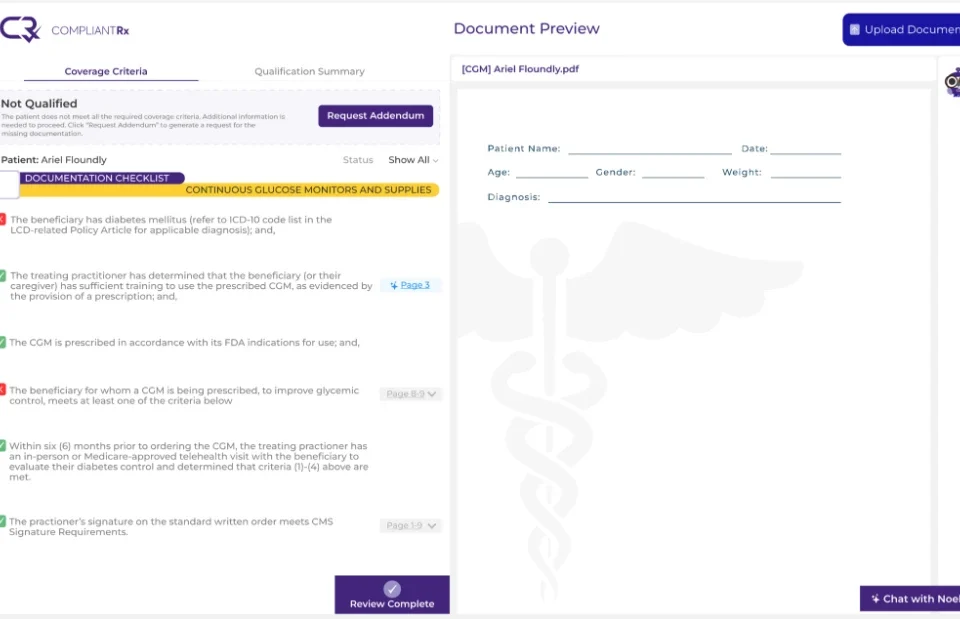
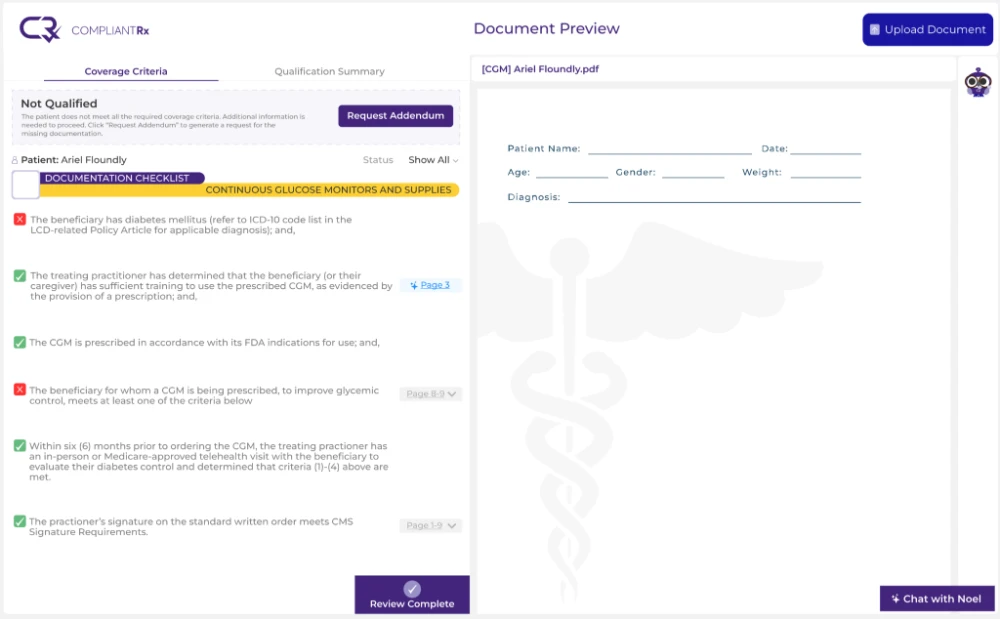
CompliantRx is built around the top criterion on that list. At intake, it checks incoming documentation against payer and product specific rules and flags what is missing. Addendum Intelligence™ then generates corrective language to send back to the provider, so the record is complete and compliant before a prior auth request goes out.
This also saves time at the order level. Reviewing an order by hand can take 20 to 30 minutes, while the same review with CompliantRx takes 2 to 4 minutes.

CompliantRx covers the documentation side of prior auth only. It works alongside your submission or portal workflow, it does not submit requests or make approval decisions, and it integrates with systems of record such as Brightree and NikoHealth. See the integrations CompliantRx supports.
CompliantRx was also built by a DME operator who handled these orders firsthand, so its checks reflect how intake work really happens.
Schedule a demo to see how CompliantRx makes prior auth requests complete before they are submitted.
FAQs
- What should I look for in prior authorization software?
Documentation checking before submission should come first, followed by payer coverage, status tracking, DME specific rules, and integration with your system of record.
- Does prior authorization software reduce denials?
It can, but only if it checks documentation before submission, since speed alone does not prevent denials.
- What is the difference between software that submits and software that validates?
Submission software sends the request, while validation software first makes sure the request is complete, which is the part that helps prevent denials.