

Prior Authorization Software: The Criterion That Actually Matters for DME
October 5, 2026
Outsourcing medical billing means handing your claims work to an outside team. For many DME suppliers, that is a sound move. It can ease staffing pressure and bring in billing expertise.
But outsourcing moves billing work to someone else. It does not remove it. The costs that get overlooked stay on your side: handover time, vendor oversight, and the documentation work that happens before billing starts.
Here is a fair look at what outsourcing fixes, what it relocates, and where the rest of the work lands.
What does it mean to outsource medical billing?
To outsource medical billing is to contract a third party to handle some or all of your billing work. That usually includes claim submission, payment posting, and denial follow-up.
Vendors tend to price their services in one of three ways:
- Percentage of collections: the most common model. Industry guides commonly cite 4% to 8% of collections, though it varies by vendor and scope.
- Per claim: a set fee for each claim submitted.
- Flat monthly fee: a fixed amount, often tied to expected volume.
Before signing, check what the fee actually covers. Add-on charges can raise the total.
Where outsourcing genuinely wins
For teams short on billing staff, the advantages are real:
- Specialized expertise without hiring. A good vendor already knows DME billing rules, so you skip the recruiting and training.
- Room to scale. Vendors can absorb higher claim volume without you adding headcount.
- Less turnover risk. If a biller leaves, your billing does not stall.
- Costs that are easier to plan. Flat or hybrid fees simplify budgeting, while percentage fees rise as collections grow.
These benefits deserve serious weight. They just do not cover the whole workflow.
What outsourcing relocates rather than removes
Outsourcing moves the billing labor. But in DME, much of the work that causes denials happens before billing, at intake.
A billing partner works with whatever record they receive. They cannot fix a thin chart, so the documentation burden stays with your intake team either way.
Then there are the costs vendor pages tend to skip:
- Handover time. Your team has to teach the vendor your products, payers, and processes.
- Ongoing oversight. Someone still reviews reports, checks rejected claims, and manages the relationship.
- Lost institutional knowledge. When work leaves your building, the know-how behind it often goes too.
Want to see how manual intake compares to automation? Read our guide to manual vs AI-powered DME processes.

In-house vs. outsourced vs. fixing the root
Here is how the three approaches compare on the factors that matter most.
| Factor | In-house | Outsourced | Intake automation |
| Where the work sits | Your billing team | An outside vendor | Your intake process, before billing |
| Cost structure | Salaries, software, and training | Percentage, per-claim, or flat fee | Software cost, separate from billing fees |
| DME expertise | Depends on who you hire | Varies by vendor | Payer and product rules built in |
| Effect on denials | Depends on intake quality | Depends on the record handed over | Helps catch documentation gaps before submission |
| Knowledge retention | Stays, but tied to individuals | Moves to the vendor | Captured in rules and checklists |
These options solve different problems. In-house and outsourced billing decide who does the billing work. Intake automation addresses the quality of the record before billing begins. Many suppliers end up needing to look at both.
The part neither option fixes: intake
Whichever billing route you choose, documentation-driven denials start upstream, and neither option addresses that.
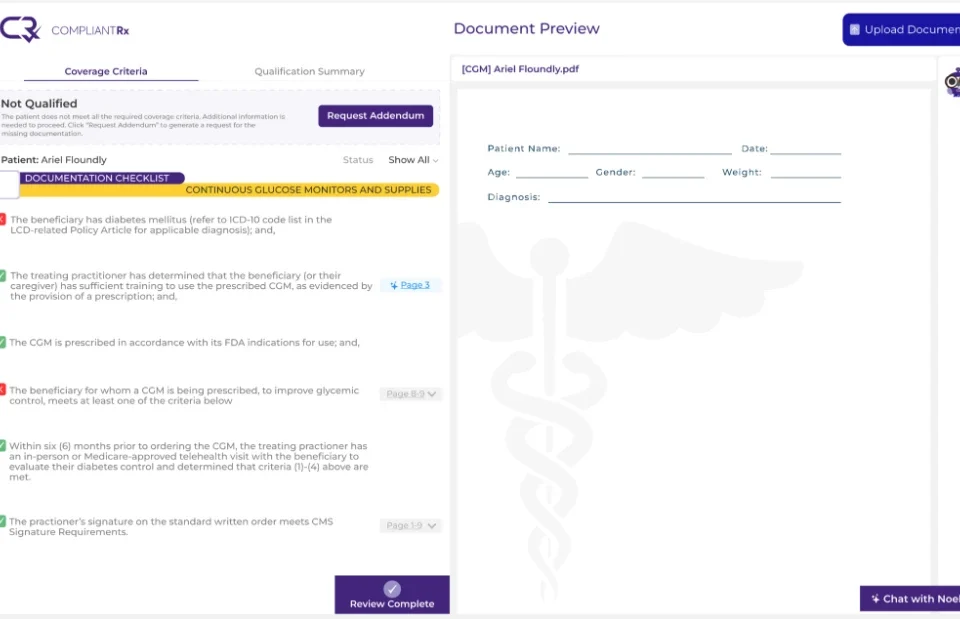
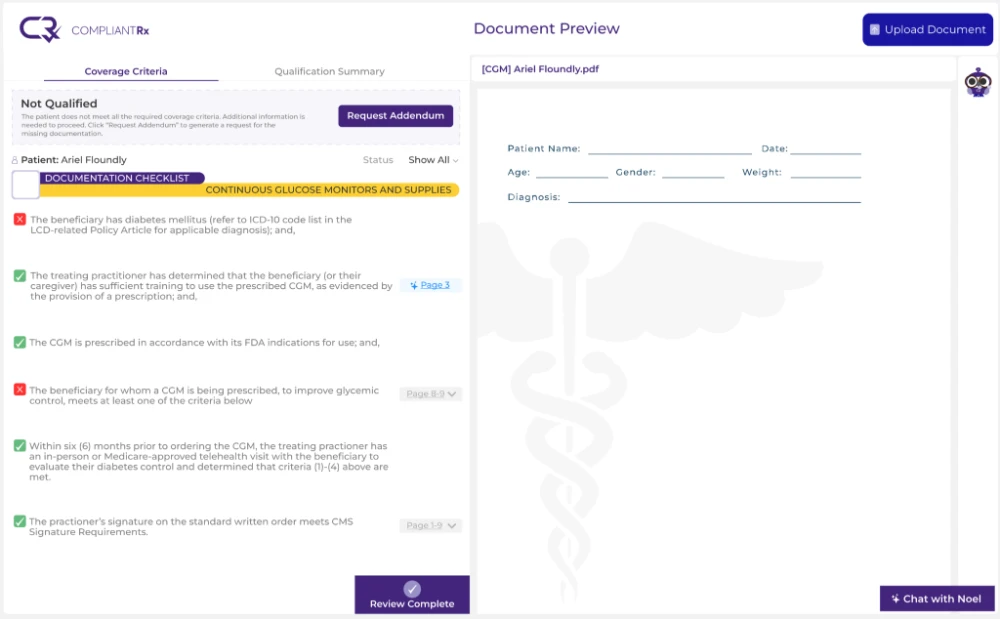
CompliantRx works at that stage, ahead of the billing decision. When an order arrives, usually by fax, the platform checks the documentation against payer and product rules and flags what is missing. Addendum Intelligence™ then generates corrective language to send back to the provider.
Once the record is complete, it is pushed back to your system of record, such as Brightree or NikoHealth.
Reviewing one order by hand can take 20 to 30 minutes. With CompliantRx, it takes 2 to 4 minutes.
CompliantRx is not a billing tool, and it does not replace your billing team or a billing vendor. It gives them cleaner records to work from. Learn more about AI medical record review.
Schedule a demo to see how CompliantRx gives your billing team, in-house or outsourced, clean records to work from.
FAQs
- How much does it cost to outsource medical billing?
Most vendors charge a percentage of collections, commonly cited at 4% to 8% and sometimes up to 10%. Per-claim and flat-fee models also exist. These ranges come from billing providers, not a neutral industry source, so confirm the exact fee and what it covers before signing.
- Is outsourcing cheaper than in-house?
It depends on volume, scope, and fee model. Compare your full in-house cost with the vendor fee plus oversight time.
- Can you outsource billing and still have denial problems?
Yes. A billing partner can only work with the record they receive, so incomplete intake documentation can still lead to denials.